

We excel in delivering high-quality OEM and ODM solutions for our partners,
enabled by cutting-edge technology and scalable manufacturing expertise.
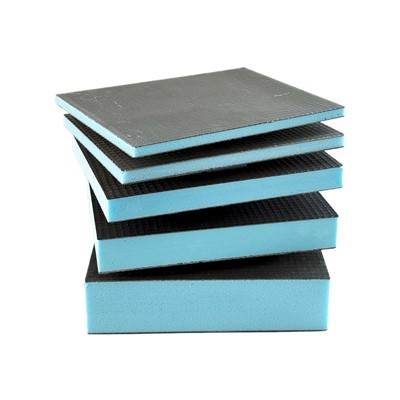
Its core substrate is mostly made of high-density expanded polystyrene (EPS) or extruded polystyrene (XPS) foam, with a density of only 0.03-0.06g/cm³, weighing 1/5 to 1/3 of traditional cement backboards. However, it reaches the IPX7 waterproof standard through scientific structural design, making it an optimal choice for small apartments, old house renovations, and lightweight construction.
The foam waterproof backer board is laminated with 160g/m² mesh on both sides. After being impregnated with polymer mortar, the flexural strength is increased to 5MPa, which can firmly support large-format tiles. The surface is coated with 0.3mm thick butyl rubber, which is bonded to the foam substrate through a hot-melt process. It can be directly hot-melt-welded in complex areas such as pipe joints and corners to form a seamless waterproof membrane, eliminating the risk of leakage.
Foam waterproof backer board is primarily used on interior walls and partitions, particularly for applications such as light steel stud partitions, lightweight partitions, and wall leveling. It provides a stable base for subsequent finishing materials, enhancing the wall's sound insulation and thermal insulation, while also resisting mold and moisture. Its rapid leveling function significantly improves construction efficiency, adapting to a variety of building requirements.
When tiling walls, consider whether the base is relatively flat or uneven, as the installation method will differ.
For walls with a relatively flat base
First, clean the base and level it with cement mortar. After the mortar has dried, lay the foam waterproof backer board. You can use a thin layer of cement mortar or dry-lay it directly with tile adhesive. Use anchors to reinforce the joints and apply fiber mesh tape. Use a specialized tool to smooth the sealant over the fiber mesh tape.
For tiling on uneven walls
Reserve eight marked holes on the foam waterproof backer board sheet. Apply a thick bead of mortar to the marked holes. Place the sheet on the wall and align it with a rubber hammer. After the mortar has initially set, use an 8mm drill bit to drill 5cm into the base wall through the marked holes. After the mortar has fully set, hammer the anchors into the marked holes. Seal the joints and anchors with fiber mesh tape and sealant.
The excellent performance characteristics of foam waterproof backer board determine its wide application.
RV Bathroom
The lightweight design of 3kg/m² is suitable for vehicle loading, and the low temperature resistance of -20℃ meets outdoor use requirements.
Ultra-Thin Tile Paving in Bathroom
The 6mm thickness model can save 0.012㎡/m² of space, suitable for small bathrooms ≤5㎡.
Balcony Waterproof Renovation
Directly cover old tiles and match with self-adhesive foam backboard to complete balcony waterproof construction within 2 hours.
Swimming Pool Landscape Wall
The foam backboard is integrally pasted with tiles, replacing traditional stone dry hanging, reducing costs by 40%.
The sizes of foam waterproof backer boards we use are different for different application fields. Although its specifications are 1220mm×2440mm×1300mm, we can customize it according to actual needs.


Hot Tags: foam waterproof backer board, China foam waterproof backer board manufacturers, suppliers, factory, 100 Waterproof Tile Backer Board, Insulated Waterproof Backer Board, Waterproof Backer Board for Shower, Waterproof Backer Board for Shower Walls, Waterproof Tile Backer Board 6mm, Waterproof Tile Board